The Human Brain Was Not Built for the Infinite Feed
balance is architecture
I think humans are biologically close to a breaking point.
Not because people are weak. Because the environment changed faster than the body did.
Our ancestors did not wake up with the whole world one tap away. They did not carry every war, every market signal, every technical breakthrough, every argument, every emergency, every opportunity and every stranger’s opinion in their pocket. They did not have a glowing rectangle that could summon more information in ten minutes than a village used to see in a month.
I do.
Most of us do.
And if I am honest, I feel it. Not every day in a dramatic way, but in the background. That pressure of not keeping up. The latest AI model. The latest news. The latest business move. The latest thing I should know before someone else knows it. The latest tool that might save me time if only I had the time to learn it.
That is a strange kind of modern tiredness. You are not physically carrying a load, but your mind is carrying open loops all day.
So my personal take is simple: the human brain is not ready for this amount of input without help.
The numbers match the feeling
I do not want this to be only a mood piece. The feeling has data behind it.
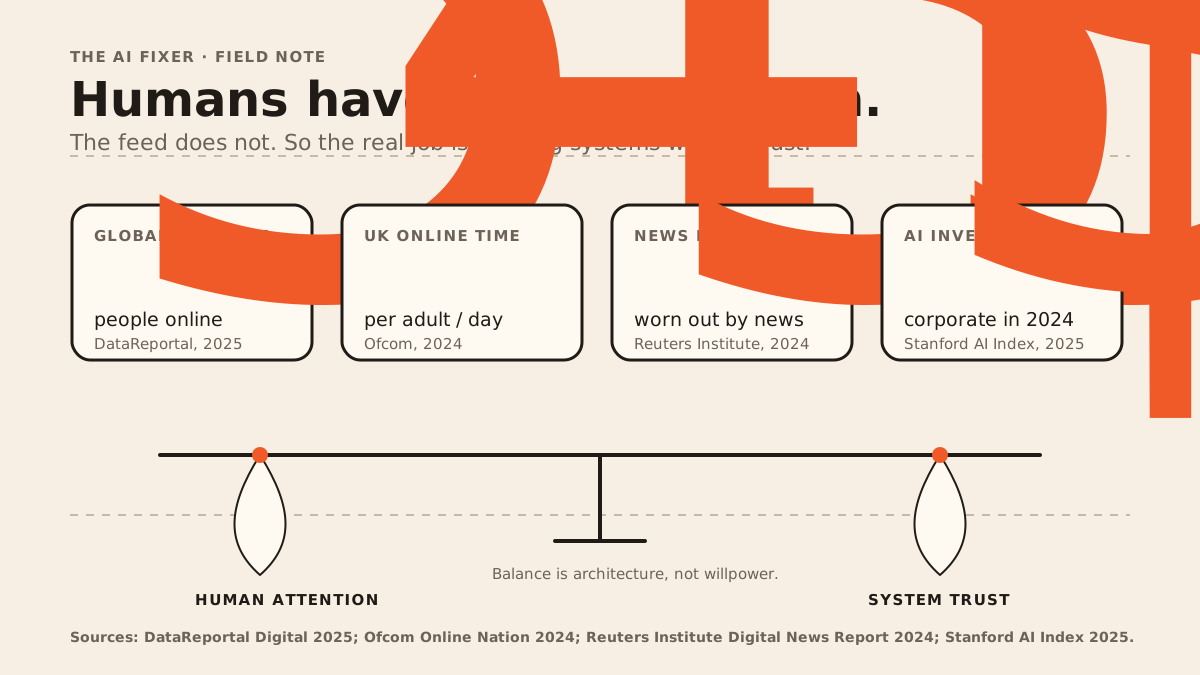
DataReportal’s 2025 global overview says 5.56 billion people were using the internet at the start of 2025, with 5.24 billion social media user identities worldwide. That is not just a communication network. That is a planet-scale attention machine.
Ofcom’s Online Nation 2024 report says UK adults spent an average of 4 hours 20 minutes a day online across smartphones, tablets and computers in May 2024. Younger adults were higher again: 18–24-year-olds averaged 6 hours 1 minute a day.
Reuters Institute’s Digital News Report 2024 found that across markets, around four in ten people — 39% — said they felt worn out by the amount of news these days, up from 28% in 2019.
Stanford’s AI Index 2025 says corporate AI investment reached $252.3 billion in 2024, with private investment in generative AI at $33.9 billion. It also says industry produced 90.2% of notable AI models in 2024.
Put those together and the shape is obvious:
- more people online
- more time online
- more news fatigue
- more AI power concentrated in corporate infrastructure
- more dependency on systems most people do not control
That is the environment we are asking a normal human nervous system to survive.
Willpower is not enough
The lazy answer is: just disconnect.
I do not buy that.
For some people, maybe. But for people building businesses, repairing real things, supporting customers, learning new tools, raising a family, managing servers, keeping up with AI, handling money, and trying not to fall behind, disconnecting is not a real strategy. It is a holiday, not an operating system.
The problem is not that information exists. The problem is that it arrives unfiltered, unprioritised and emotionally weaponised.
A human brain is good at attention. It is terrible at infinite attention.
That is why I had to build systems.
Not because I wanted to be clever. Because I needed a way to stay useful without burning out.
My answer was architecture
I started building workflows because I could feel my brain becoming the bottleneck.
I needed systems that could:
- watch things without me staring at them
- summarise without turning everything into noise
- remind without nagging
- route tasks to the right place
- separate personal, business and customer contexts
- keep secrets out of places they do not belong
- tell me what needs action and what can wait
- let me work from evidence instead of panic
That is what AI agents became for me.
Not toys. Not chatbots. Not magic staff.
More like a workshop around my attention.
I had to learn that the hard way. At first I tried to keep too much in my head. Then I tried to let the agent remember too much. Then I had to clean the memory, separate profiles, build gates, create workflows, add verification and make the system more boring.
Boring is good. Boring means it works when I am tired.
The goal was never to replace my judgement. The goal was to protect it.
The family part is harder
There is another side that people do not talk about enough.
Humans are social beings. We are not meant to optimise ourselves like servers and then call that a life.
Family matters. Time matters. Peace in the house matters. Being present matters.
I cannot pretend I am the best at this. I am not. I get pulled into systems, servers, diagnostics, AI, websites, urgent jobs, ideas that will not leave me alone. Sometimes I am too deep in the machine.
But that is also why I care about building better systems.
A good system should not only make a business faster. It should remove friction from the human side too.
It should reduce stress. It should free time. It should make planning easier. It should stop small jobs turning into mental clutter. It should help the house run smoother without making the house feel managed by software.
That balance is delicate.
The wrong automation makes life colder.
The right automation gives people space back.
I am still working on that part.
I have not met Jarvis yet
People like the word Jarvis because it represents something clean: a trusted system that understands enough, acts enough, protects enough, and stays out of the way enough.
I have not met that system yet.
But I do think I am on the path.
I can see a day when I breathe fresh air, clear my mind for a few good moments, and know that the system I built is watching the right things. Not watching everything. Not controlling everything. Watching the right things.
That distinction matters.
A trusted AI system should not flood me with more information. It should reduce the number of things I have to carry.
It should say:
- this matters now
- this can wait
- this is noise
- this needs a human
- this is risky
- this is done
- this is not your problem tonight
That last one might be the most valuable feature in the whole stack.
Trust is the real product
The important bit is trust.
Not blind trust. Earned trust.
Trust between humans and AI systems. Trust that the system will not leak private context. Trust that it will not silently change the rules. Trust that it will not route my life through someone else’s priorities. Trust that it will say “I do not know” instead of making things up. Trust that it will stop before doing something expensive, dangerous or irreversible.
And trust is exactly where the current world feels unstable.
Because the biggest systems are not neutral utilities. They are owned by corporations. They decide what you see, what gets ranked, what gets recommended, what gets restricted, how much compute you can use, what model you can access, when you are rate-limited, what gets filtered, what disappears behind a policy change, and how your data flows through the machine.
I am not saying those companies are useless. That would be dishonest.
We would not be building this fast or this well without them. The frontier models, APIs, hardware supply chains, documentation, developer tools and research pressure have pushed everything forward.
But dependence is not the same as trust.
And speed is not the same as freedom.
Why local and private AI resonates with me
This is why words like off-grid, offline, local AI and private compute hit something deep in my mind.
It is not because I want to hide something.
It is because I want to control the tools I depend on.
There is a big difference.
People building local and private AI architectures are often framed like they are paranoid. Some are. Most are not. Many are just independent people who have been given superpowers and can see the catch.
They want systems that:
- work when an API is down
- keep private data private
- do not change behaviour overnight because a provider changed policy
- do not put every personal or business process inside a corporate black box
- can be inspected, backed up, moved and repaired
- use cloud intelligence when it helps, but do not collapse when the cloud says no
That is not hiding.
That is ownership.
A mechanic understands this instinct. If the tool is essential to your work, you want to know where it is, how it works, how to repair it, and what happens when it fails. You do not want every spanner to phone home before it turns a bolt.
The future is not just governments
I do not think the future will belong mainly to governments.
I think more and more of it will belong to corporations that operate like private infrastructure states: compute, payments, identity, search, feeds, maps, cloud, app stores, models, devices, advertising, data, communication.
Some of that is efficient. Some of it is dangerous.
Governments can be slow, clumsy and political. Corporations can move faster, but they are not democracies. Their first responsibility is not your freedom. It is their own survival, growth and shareholders.
That does not make them evil. It means the incentives are different.
So the independent builder has to think carefully.
Use the big systems, yes. Learn from them, yes. Build with them, yes.
But do not surrender the whole stack.
Keep a local path. Keep backups. Keep open models where possible. Keep your data exportable. Keep your workflows understandable. Keep your agent memory clean. Keep the final authority human.
That is the balance I am trying to find.
The balance I want
I do not want a bunker.
I do not want to reject cloud AI, corporate tools or frontier models. That would be stupid. Some of the best work I have done was only possible because these systems exist.
But I also do not want my future to depend completely on someone else’s dashboard.
The balance I want is hybrid:
- local first for private memory, sensitive workflows and continuity
- cloud when the job needs frontier reasoning or scale
- human approval for risky actions
- profile isolation between personal, business and customer contexts
- source-grounded briefings instead of doom feeds
- family-supporting automation, not family-replacing automation
- systems that earn trust by being inspectable and reversible
That is my path towards something like Jarvis.
Not a voice in the ceiling. Not a demo. Not a sci-fi servant.
A trusted layer between a human life and an infinite information environment.
The point
People are tired because the world became too searchable, too fast, too loud and too algorithmic for an unaided mind.
The answer is not to pretend we can go back.
The answer is to build better filters, better agents, better boundaries and better local control — then use the big systems without becoming dependent on them for everything.
That is where I think the serious work is now.
Not just making AI smarter.
Making AI trustworthy enough that a human can finally put some of the load down.
— John
Sources I checked
- DataReportal — Digital 2025 Global Overview Report: 5.56 billion internet users and 5.24 billion social media user identities at the start of 2025.
- Ofcom — Online Nation 2024: UK adults averaged 4 hours 20 minutes online per day in May 2024; 18–24-year-olds averaged 6 hours 1 minute.
- Reuters Institute — Digital News Report 2024: around 39% across markets said they felt worn out by the amount of news, up from 28% in 2019.
- Stanford HAI — AI Index Report 2025: corporate AI investment reached $252.3 billion in 2024; generative AI private investment reached $33.9 billion; industry produced 90.2% of notable AI models in 2024.
Reply to this note
Corrections, field notes and disagreement are welcome.
Keep it operator-grade. Do not send customer names, addresses, number plates, VINs, private workshop details, credentials, private IPs or anything that should not be public.
Serious replies may be quoted later only with permission.